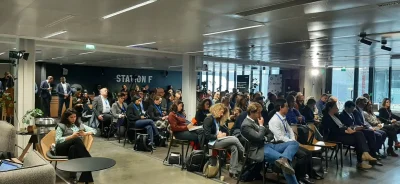
At the first edition of Forward by Silamir event at Station F on January 20, Sonia MAGALHAES, Strategic Account Executive at Microsoft, Alstom Transport, gave us his diagnosis of the reality of AI within major French companies, highlighting in particular the friction points encountered by management committees.
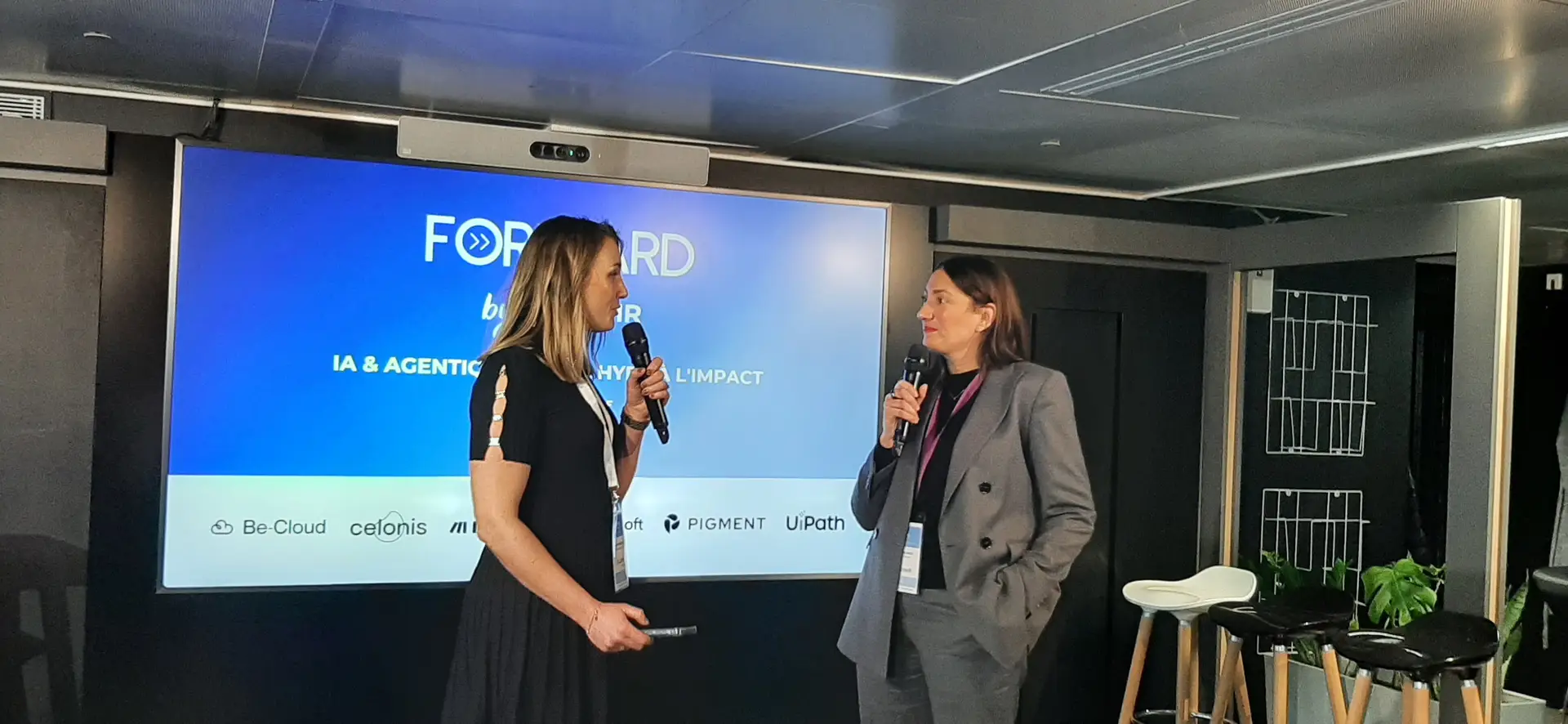
January 20 at StationF: Déborah VERGNOLLE - CMO of Silamir - and Sonia MAGALHAES, from Microsoft
The 4 major challenges facing French CXOs
For Sonia MAGALHAES, In this article, we take a look at some of the key challenges faced by general management in the move to AI. She identifies four issues that are systematically raised by senior management:
- Sovereignty A constant source of tension, especially for an American player like Microsoft, which must meet the requirements of trust and local data protection.
- Data governance Many companies realize that their data assets are still lying fallow. The compliance and organization of this data is still a work in progress.
- The skills AI is redefining jobs and posing immediate challenges in terms of cybersecurity and team training.
- Industrial specificity The time for generic AI is over. Value now lies in the ability to address highly specialized, industry-specific issues.
The rope spirit versus the gadget effect
One of the lessons we learned from our exchange was the human dimension of transformation. Sonia emphasizes that for a technology to have a real impact, it must be driven by visionary leadership.. It uses the strong image of «l'esprit de cordée» to describe the need to get all employees on board. Without real traction from leaders and a genuine sense of collective responsibility, AI risks remaining perceived as a mere gadget, a technological curiosity with no operational tomorrow.
This human transformation goes hand in hand with a focus on ROI.
Today, the challenge has shifted. While tools such as Copilot promote individual productivity, it is sometimes difficult to isolate it in financial results. The real challenge now lies at the level of the entire company. Sonia Magalhaes insists on «business efficiency»: aiming for scalability and overall operational efficiency rather than just individual time savings - a challenge that is still ahead of us.
Industrializing AI through business value and the operating model
When asked about the critical factor for transforming generative AI, Sonia Magalhaes advocates a rigorous discipline: it all starts with a surgical qualification of the use case métier. Before any deployment, the key is to assess the business value and potential ROI upstream. The aim is not to multiply small, isolated tests, but to identify high value-added use cases on a company-wide scale.
Once these priorities have been set, the challenge shifts to execution. For Sonia, the ability to deliver refers directly to the organization itself: what operating model to ensure that these solutions don't just remain prototypes, but are actually integrated into the company's day-to-day operations?
The Silamir approach and the strength of its systemic vision
According to the Microsoft expert, this is where Silamir's approach stands out. She sees it as an indispensable systemic vision to navigate the complexities of generative AI. By acting simultaneously on the technological lever and the operational model, Silamir ensures crucial coherence: aligning technical tools with business processes and organizational structures. According to Silamir, it is this holistic approach that transforms technological innovation into industrial success.
Boldness, a lever for innovation
To conclude, Sonia MAGALHAES calls for a radical change of attitude to «unleashing innovation». She regrets a certain tendency towards conformism, often adopted to avoid upsetting customers' habits. For her, the future belongs to those who dare. challenging certainties : «There are some subjects where you shouldn't hesitate to be bold.» Moving forward therefore also means accepting the boldness needed to break new ground!