We use cookies to improve your browsing experience and analyze our traffic. To find out more, read our Terms of use. By clicking on "Accept", you agree to the use of our cookies.
Would you like to talk to Silamir Group? Leave us your contact details below and we'll put you in touch with the team best placed to answer your questions.
The world of AI is evolving at high speed: on the one hand, language models (LLMs) are progressing and are able to generate increasingly relevant content; on the other, the needs of businesses require ever more fluid integration with their tools and data.
It's against this backdrop that MCP (Model Context Protocol) is emerging as an open standard for connecting AI assistants to real-world services and information sources. In this article, you'll discover why MCP is a game-changer, how it works in broad strokes, and what concrete uses it is already enabling.
What is Model Context Protocol (MCP)?
The Model Context Protocol, introduced by Anthropic at the end of 2024, defines a standard way for an AI assistant to connect to external resources (databases, business applications, messaging tools, etc.).
The goal:
Avoid developing in-house connectors for each service.
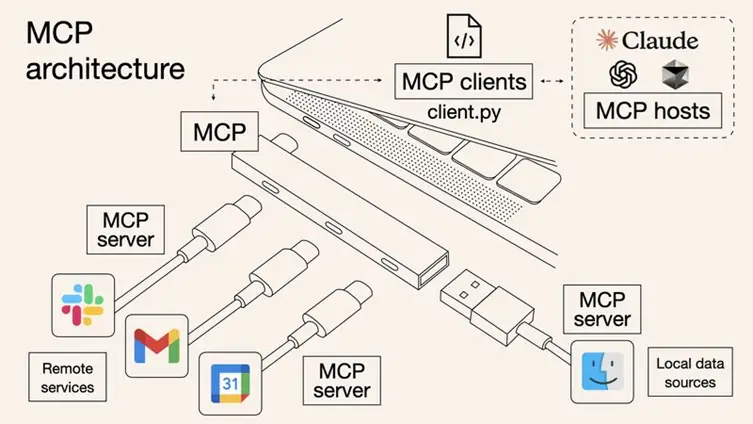
In short, MCP acts like a "USB port" for AI: you plug an "MCP server" into the assistant, and the latter immediately knows what types of actions or content it can exploit, without having to code a specific integration each time.
MCP: the universal USB port that links AI to all your services
Why such a protocol?
1. Breaking down fragmentation
Historically, even an advanced LLM remained locked in his own bubble: he knew only his own training (often frozen) and couldn't interact directly with services or up-to-date data. For each source (CRM, calendar, knowledge base...), we had to develop an ad hoc connector, which was cumbersome and not very scalable.
With MCP, we unify this approach: the AI discovers an available MCP server and immediately knows what actions or data are proposed, via a common language.
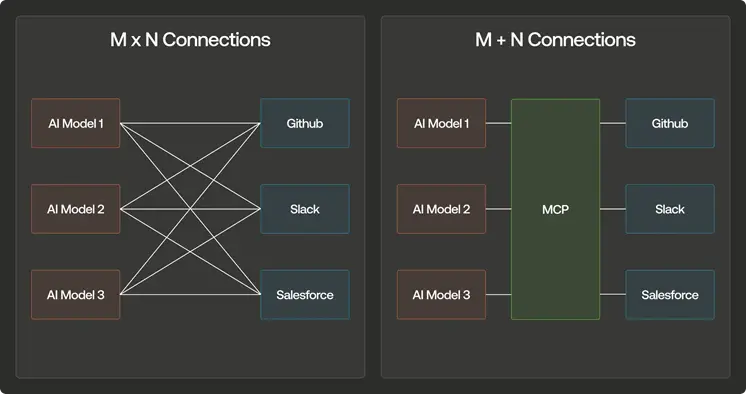
From M × N mesh to single hub: MCP simplifies every integration2. Really useful, contextual AI
AIs become more powerful when they have access to something concrete:
Corporate info (wiki, tickets, internal documents)
Real-time data (prices, inventory, weather, error logs)
Action systems (send a Slack message, schedule an appointment...)
MCP servers make it possible to "plug in" these flows of data and tools without recoding each integration. AI gains in relevance and capacity for action.
3. Standardizing safety and governance
In a professional context, you don't want to give AI carte blanche. MCP has been designed to separate AI logic (MCP host) from access logic (MCP server):
API keys or sensitive access remain on the server side
Technically, MCP operates in client-server mode:
The MCP customer is integrated into the AI application (e.g. Claude Desktop, a VS Code or Cursor extension, etc.). It receives instructions from the user.
MCP servers are processes (local or remote) that expose :
Resources (documents, data, history, etc.)
Tools (functions for interacting with apps, browsing, posting messages).
Prompts or "query templates" (to guide the AI in certain specialized tasks)
The protocol defines how client and server interact: requests (to read a document, call a function, etc.) and responses (raw data, API results, etc.) follow a single format, based on standards such as JSON-RPC.
For the end user, it's all behind the scenes. He simply sees that his AI assistant can "fetch" information or trigger actions seamlessly, without multiple manual configurations.
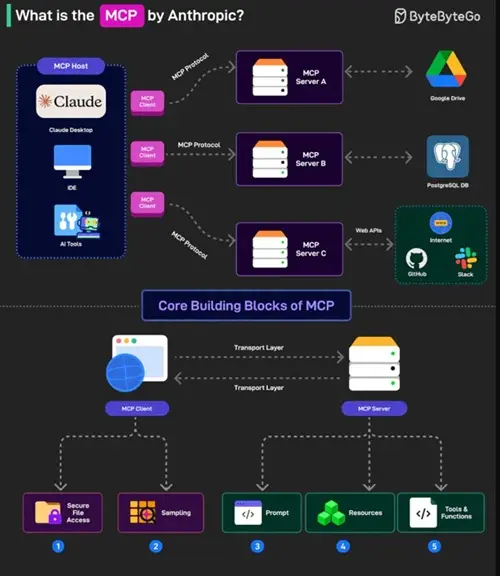
When several MCP servers are connected to a single IA host, the result is an integration hub:
Example: an AI assistant in a company can call :
A "Google Drive" MCP server (to retrieve a file)
A Git MCP server (to read code or create a branch)
A "Slack" MCP server (to send an alert message)
And so on...
AMCP architecture: one IA-host orchestrates several servers and tools
Case studies
Domain
Connected Tools (MCP Servers)
What AI does
Enterprise Collaboration & Data
Slack, Google Drive, Atlassian, SQL databases
Find a document, check Jira tickets, summarize a conversation
Development & DevOps
GitHub, Puppeteer
Create a Pull Request, propose a commit, run tests
Research and intelligence
ArXiv, Brave Search, Google News
Query recent articles, fill in its temporal gaps
Personal Assistant & Automation
Calendar, file system
Propose a time slot, send an invitation, open authorized documents
Each new MCP server immediately becomes usable by all compatible hosts—this is the network effect that accelerates the ecosystem.
Server-side API keys, validated actions, local-first mode
Development
N distinct connectors to maintain
A reusable MCP server (Python, JS…)
Once an AI host supports MCP, it connects to any MCP server — hence the interoperability and maintenance gains.
Benefits for companies and developers
Interoperability : the same protocol serves multiple services. This reduces complexity and speeds up integration.
Maintenance savings instead of having M × N connections to maintain (M tools × N AI agents), we end up with a centralized scheme: we implement MCP once, and any evolution benefits the whole.
Clear governance access filtering, action tracing, domain-based permission restrictions (e.g. read-only access to a folder).
An expanding ecosystem Each new "block" (MCP server) is immediately available to all MCP hosts. This network effect stimulates innovation.
Outlook
More agentic AI agentsWith MCP, AI can already link together complex actions: consulting logs, launching a test, posting a Slack message, editing a document... We're getting closer to the dream of a "Jarvis" assistant who orchestrates several tools in a fluid, coherent way.
Towards an industry standard Many companies have already announced their support for MCP, and all indications suggest that this protocol could become the standard for Connect AI and business services, a bit like REST or GraphQL for web APIs.
Advanced governance and security As experience is gained, access control, approval and unified logging mechanisms will be perfected. The growing power of AI calls for finer-grained supervision, and MCP offers a solid foundation for reconciling efficiency and compliance.
Expanding the ecosystem As the community develops new MCP servers for all kinds of services (ERP, marketing automation, 3D, etc.), integrating AI into our daily lives will become easier and easier.
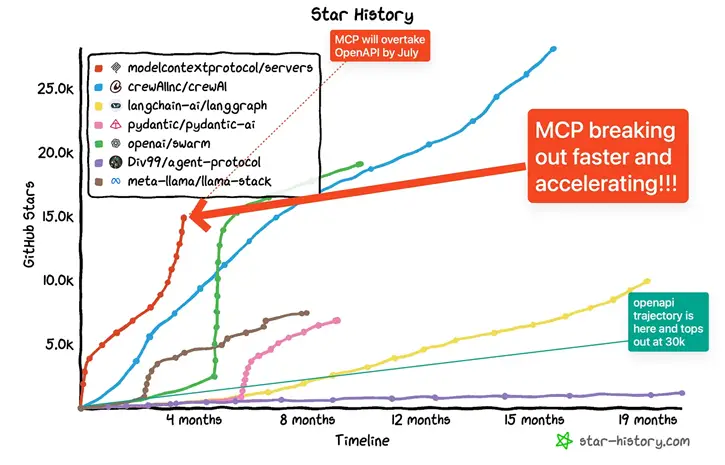
Lightning adoption: MCP's GitHub curve already surpasses other protocols
Conclusion
Initiatives like MCP demonstrate a fundamental trend: to make AI agents truly versatile, connected and capable of integrating into different environments. We're no longer at the stage of "just" asking questions of an LLM: AI can now act, interact and orchestrate multiple systems.
Google has also entered the fray with Agent2Agent (A2A), a new open protocol designed to facilitate communication between agents from different frameworks. A2A focuses on the discovery of each agent's capabilities (via "Agent Cards"), task management and secure interoperability: we find the same desire to standardize, this time for exchanges between agents. Whether it's MCP for connection to external tools or A2A for inter-agent dialogue, open protocols are multiplying and foreshadowing an ever more "connected" AI.
Coming soon: how to get started with MCP!
Discover our AI expertise and contact our experts to discuss your projects and specific needs.
The fruit of expertise from Silamir and feedback from collaborations with recognized actors From the market, this guide offers a concrete and directly applicable approach for your organization.