Who is this article for? Executives and business managers wishing to gain a better understanding of the new generation of intelligent automation, which is revolutionizing productivity and redefining roles within their organization. Approximate playback time : 5 min In short, for those who don't have the time: Agentication marks a technological leap beyond simple automation (RPA, chatbots). It's the art of making autonomous artificial intelligence agents work together, capable of making decisions, communicating with each other and carrying out complex missions. This paradigm shift transforms roles (the human becomes the «orchestra conductor» and the expert becomes the «agent architect») and raises important strategic questions, notably as to the best path for the company: to develop its own agents (Build) for total control, or to consume those of suppliers (Buy) for rapid access.
What is agentic?
Until recently, the concept of «augmented work» was limited to either to the implementation of methodological efficiency approaches such as Lean, or to deterministic automation logics such as chatbots or RPA (Robotic Process Automation), whose development and execution are based on predefined rules and without decision-making autonomy.| Criteria | Classic Automation (RPA, Chatbots) | Agentic (autonomous AI agents) |
|---|---|---|
| Operation | Predefined rules, deterministic | Autonomous decision-making, strategy adaptation |
| Autonomy | None (executes rules) | Raised (plans, decides, adjusts) |
| Collaboration | Isolated tasks | Agents that communicate and organize (e.g., A2A) |
| Managed complexity | Simple and repetitive tasks | Complex and evolving missions |
| Role of the human | Defines the rules | «Conductor who supervises |
-
- Tools available to agents (capacity for Action) : to act effectively, agents have access to concrete means of action, such as online searches, file manipulation, or transformation. This capability is now standardized by the Model Context Protocol (MCP), a protocol that provides agents with the rights and means to act on external systems. The MCP is, in a way, the “USB port for the AI Agent,” allowing agents to connect to any MCP server that exposes a tool's capabilities in a standardized way.
-
- Agent collaboration (Communication) This is the heart of agentique. To ensure efficient, secure communication, various protocols are used, such as A2A (Agent to Agent). This standardized protocol enables agents to exchange information and instructions asynchronously, and to work in parallel, securely and without constant human intervention.
-
- Human orchestration (Supervision) The human being remains the conductor, defining the scenario, launching the mission at the right time and coordinating the actions of the agents to achieve an overall objective. Solutions such as UiPath (world leader in automation and agentic pioneer), n8n or Make (low-code solutions) enable these complex workflows to be prototyped and automated.
-
- Consumer and business applications for automating complex tasks in applications. For example, AG UI (Agentic User Interface) enables a user to modify the interface of his or her customer area simply by «talking» to an agent. The MCP-UI protocol (an extension of MCP) enables an agent to generate interactive components, such as enriched product sheets on a platform (such as Shopify, for example), to offer a rich, visual shopping experience.
-
- Coding and software development Tech Lead Orchestrator: agents are used internally to accelerate development. A Tech Lead Orchestrator translates specifications into a detailed plan. Then, a parallel team of specialized agents (frontend/backend developers, API architects...) simultaneously execute their tasks under the supervision of a central orchestrator (such as Claude Code or Gemini CLI).
A new era of productivity and redefined professions
Agentique represents a profound transformation in the way we work. The role of the expert is changing, from «doer» to «master builder», focusing on strategy and supervision. ● Developers become agent architects. Instead of writing code line by line, they design and supervise teams of AI agents, who can handle front-end, back-end, database management and technical documentation writing in parallel. ● For example, the marketing team can create a workflow« where a first agent analyzes campaign data, a second writes copy for an A/B test, and a third adjusts the budget. The marketing manager then concentrates on the strategic vision. ● Project managers become «mixed team managers». A planning officer can update the project schedule and generate reports. Project managers focus on stakeholder interactions and contingency management. This of course raises questions for the world of work. Ongoing training and skills enhancement are becoming an imperative, as is the definition of new performance and recognition criteria. It is also crucial to create a corporate culture in which employees are seen as skill enhancers, not threats. This requires the implementation of acculturation logics, dedicated dialogue time within companies, and exchanges with social partners.The reality of agentique in the workplace
A consequent choice of integration options... Companies can apply several strategies to integrate agentique into their organization. The choice is based on a trade-off between several criteria, such as technical expertise, speed of deployment and investment, while also taking into account the company's maturity in these areas. 1. Internal development with workflow control (Make/Build) This approach involves developing your own AI agents in-house, while retaining full ownership and control of the workflow. It offers complete control over the design and customization of the agents and the technical environment, guaranteeing perfect alignment with the company's specific needs, constraints and processes. However, this often requires greater investment in terms of time (building skills, defining the IT architecture, etc.), technical skills and resources (human and technical). Three categories of tools can be distinguished:-
- Enterprise automation platforms such as UiPath or Power Platform They offer a secure, ready-to-use ecosystem, enabling drastically accelerated go-to-market and large-scale deployments. They provide the necessary governance, infrastructure, integration and orchestration building blocks.
-
- Low-Code platforms They also enable agents to be created with greater control over the development cycle. Their main vocation is flexibility and rapid prototyping, focusing on application integration and automation of more targeted workflows (although they offer more and more options to address increasingly complex use cases).
-
- Apart from the use of platforms, it is still possible to use a “full custom” development mode” Agentication: this involves building a complete agentic architecture by combining traditional programming languages (Python, Java...) with specific technical libraries or frameworks (LangChain, CrewAI, AutoGen...). This model offers maximum flexibility in terms of customization and integration with customers“ technical ecosystems, but requires fully autonomous management of the technical infrastructure to deploy and operate the agents, which calls for an advanced level of technical maturity. Considering the relative maturity of the sector and the rapid evolution of technologies and frameworks, this ”full custom" strategy, if poorly managed, could also lead to increased technical debt.
To conclude this first part
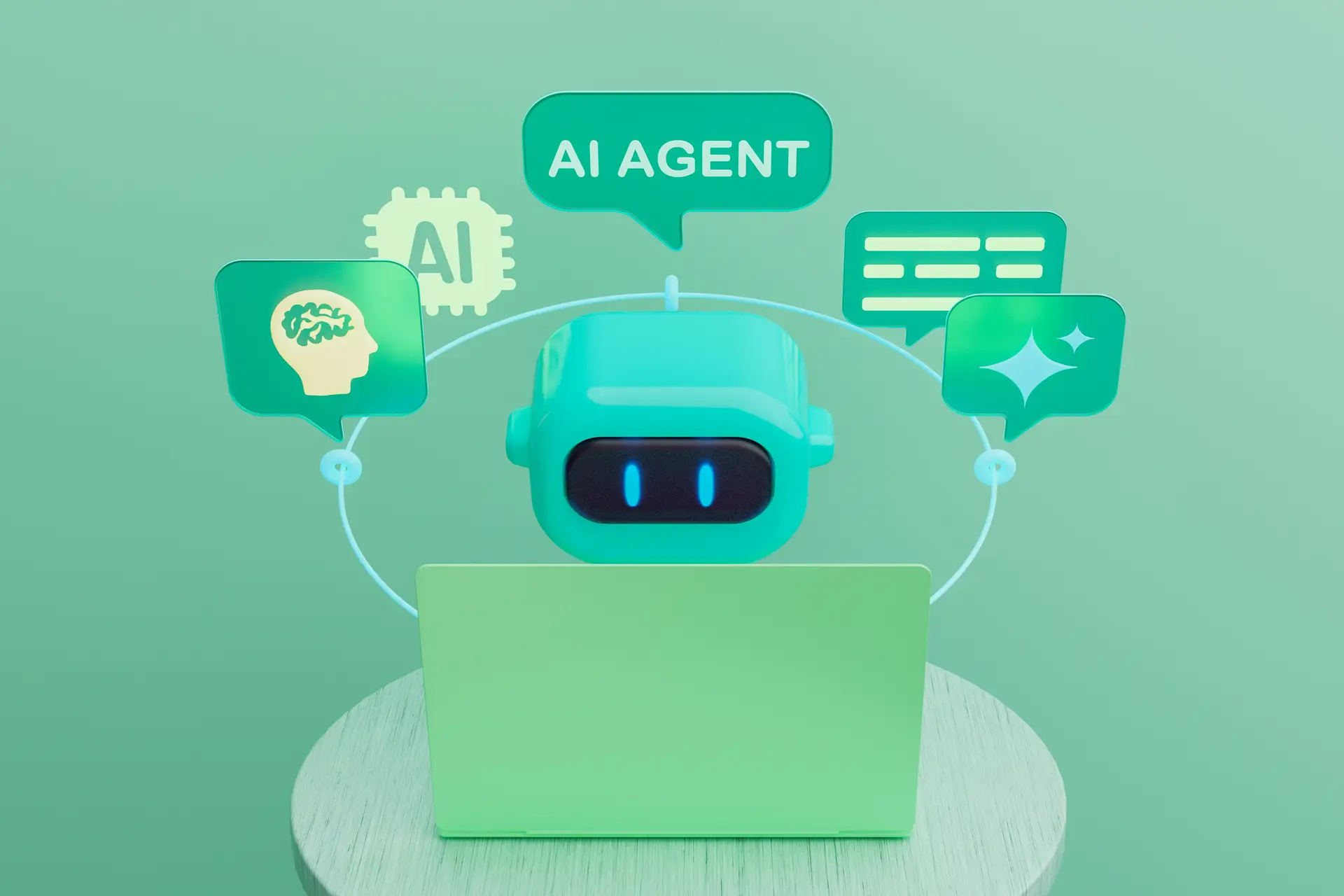
IA Agentique: From Experimentation to ROI